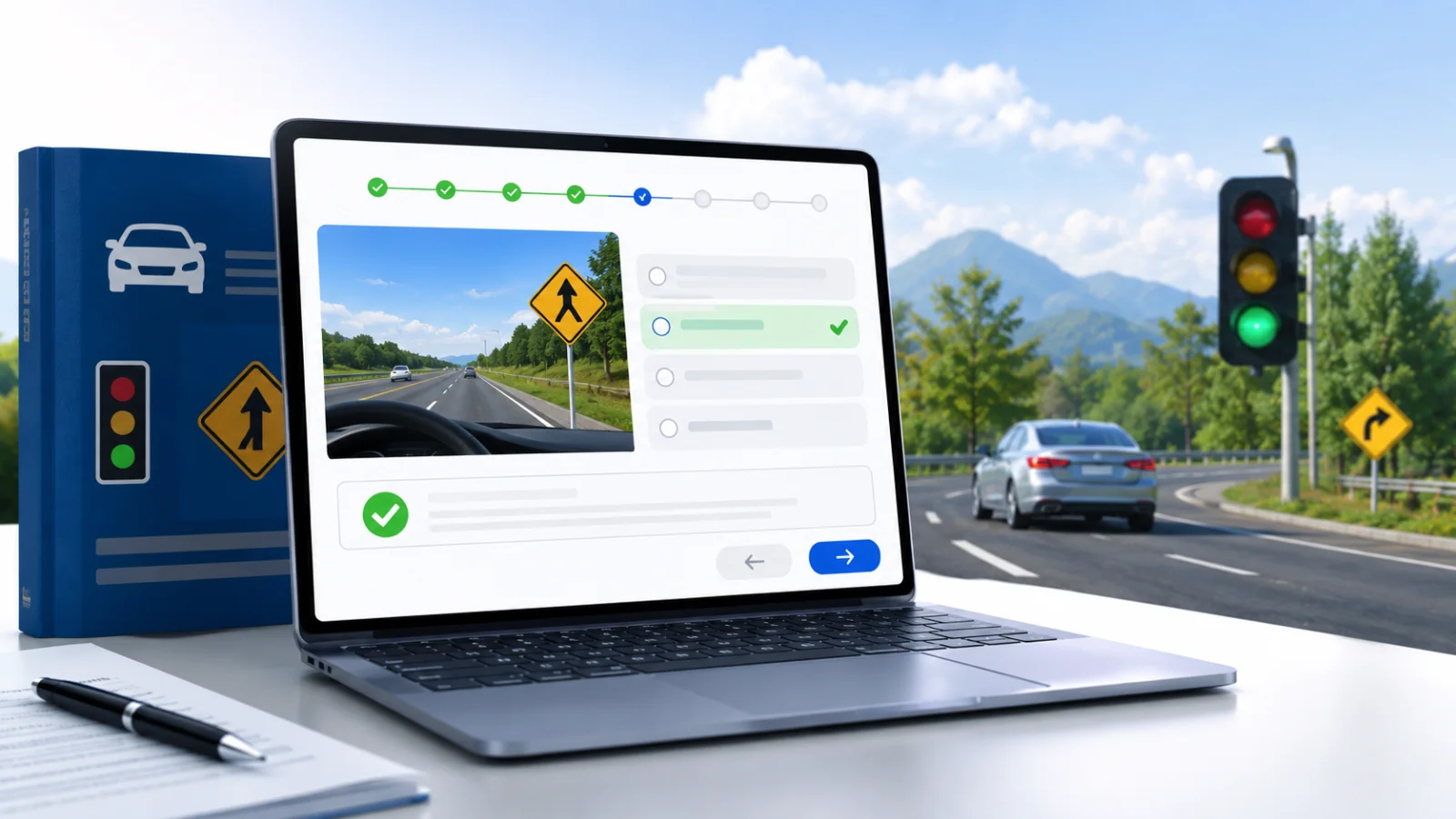
Getting ready for your DMV written test? Use this practice test to review road signs, traffic laws, right-of-way, and safe driving decisions. Answer each question before checking the explanations, then use any missed questions to guide your next study session.
These are original practice questions—not official DMV questions. Written test topics, procedures, and laws can vary by state, so use your state’s current driver handbook as your main study resource.
Practice Questions
Choose the best answer for each question. If this page includes an interactive quiz, show the answer key and explanations after the user submits their responses.
1. What should you do at a flashing red traffic signal?
A. Slow down and continue without stopping
B. Stop, then proceed when it is safe
C. Stop and wait for the signal to turn green
2. What does a steady yellow traffic signal mean?
A. The signal is changing; stop if you can do so safely
B. Speed up to clear the intersection
C. Traffic in every direction must stop immediately
3. Before changing lanes, what should you do?
A. Signal, check your mirrors and blind spot, and move only when safe
B. Check your rearview mirror and move immediately
C. Honk and move into the next lane
4. When driving in heavy rain, what is the safest adjustment?
A. Follow the vehicle ahead more closely
B. Increase your following distance and reduce speed as conditions require
C. Use cruise control to maintain a steady speed
5. A pedestrian is crossing in front of you at a crosswalk. What should you do?
A. Yield and wait until the pedestrian has safely crossed your path
B. Drive around the pedestrian if the opposite lane is clear
C. Honk so the pedestrian will move faster
6. When entering a freeway from an entrance ramp, you should:
A. Stop at the end of the ramp, even if traffic is clear
B. Yield to traffic already on the freeway and merge when there is a safe opening
C. Expect freeway traffic to stop for you
7. Railroad crossing lights are flashing and the gate is down. What should you do?
A. Drive around the gate if you do not see a train
B. Stop and wait; do not cross until the warning has ended and it is safe
C. Stop, then proceed if the train is far away
8. If your vehicle begins to hydroplane, what is a safer response?
A. Ease off the accelerator and avoid sudden braking or steering
B. Brake hard and turn sharply toward the shoulder
C. Accelerate until the tires regain traction
9. In a work zone, you see temporary signs and a flagger directing traffic. What should you do?
A. Follow the flagger’s directions and proceed cautiously
B. Follow the usual speed limit and ignore temporary signs
C. Pass other vehicles to leave the work zone sooner
10. You are tired and having trouble focusing while driving. What is the safest choice?
A. Turn up the radio and continue
B. Stop somewhere safe and take a break before continuing
C. Drive faster so you can reach your destination sooner
Answer Key and Explanations
- B — Stop, then proceed when it is safe. Treat a flashing red signal as a stop. Check for other road users before moving.
- A — The signal is changing; stop if you can do so safely. Do not speed up to beat the light.
- A — Signal, check your mirrors and blind spot, and move only when safe. A signal communicates your intention, but it does not guarantee the lane is clear.
- B — Increase following distance and reduce speed as conditions require. Wet roads can affect traction and stopping distance.
- A — Yield and wait until the pedestrian has safely crossed your path. Stay alert for people in crosswalks, including when turning.
- B — Yield to freeway traffic and merge when there is a safe opening. Adjust your speed to traffic when possible and avoid forcing your way into a lane.
- B — Stop and wait. Never drive around a lowered gate or ignore active crossing signals.
- A — Ease off the accelerator and avoid sudden braking or steering. Sudden movements can make it harder to regain control.
- A — Follow the flagger’s directions and proceed cautiously. Temporary signs and traffic control may change the normal flow of traffic.
- B — Stop somewhere safe and take a break. If you cannot stay alert, continuing to drive may put you and others at risk.
What Does the DMV Written Test Cover?
A DMV written test, also called a knowledge test or permit test, checks how well you understand driving rules and safe-driving practices. Depending on the state and license type, topics may include traffic signs, signals, right-of-way, lane use, intersections, sharing the road, and the effects of alcohol or drugs.
The exact test is not identical everywhere. For example, the California DMV describes its original-license knowledge test as multiple choice and points applicants to the California Driver’s Handbook and sample tests for preparation. New York’s Driver’s Manual describes topics including rules of the road, safe driving, road signs, and laws about alcohol and drug use while driving. Check your own state’s DMV materials for the applicable test topics and requirements. (CA)
How to Use This DMV Practice Test
Try to answer each question without looking at the answer key. Afterward, review every explanation—not only the questions you missed. This helps you confirm what you understand and spot areas that need more study.
If you get a question wrong, look up the topic in your state’s driver handbook. For example, if you miss a question about right-of-way, review that section and consider what you would do in a similar situation on the road. Then take the practice test again later to see whether you can answer confidently.
Practice tests are most useful as a study aid, not as a replacement for the official handbook. The California DMV also recommends reviewing its handbook and sample tests as part of knowledge-test preparation. (CA)
Tips to Prepare for Your DMV Written Test
Study a little at a time. Break the handbook into manageable sections instead of trying to memorize everything in one sitting. You might study signs one day, right-of-way the next, and safe driving situations after that.
Understand the rule behind the answer. Memorizing a choice may help with one question, but understanding why a rule exists can help you apply it to different situations.
Read each question carefully. Watch for words such as safest, first, must, and when safe. They can change what the question is asking.
Review mistakes instead of guessing again. Keep track of the topics you miss and revisit those sections in the handbook. Repeatedly taking quizzes without understanding the explanations may not address what you need to learn.
Use current, state-specific materials. A general U.S. practice test can help you review common knowledge, but your state’s driver handbook is the resource to use for state rules, test instructions, and local requirements.
Frequently Asked Questions
Is this the official DMV written test?
No. This is an independent practice resource with original questions. It is not an official DMV exam and does not guarantee that the same questions will appear on your state’s test.
Are DMV written tests the same in every state?
No. Test procedures and requirements can differ by state and license type. Use the official handbook and testing information published by your state’s DMV.
How should I use a DMV written test practice test?
Answer the questions first, review the explanations afterward, and use your mistakes to decide what to study in the handbook. Retake practice questions to check your understanding.
What if I am studying for a motorcycle or commercial license?
Use the handbook and test-preparation materials for the specific license you are applying for. Motorcycle and commercial driver tests may cover different material than a regular passenger-vehicle knowledge test.