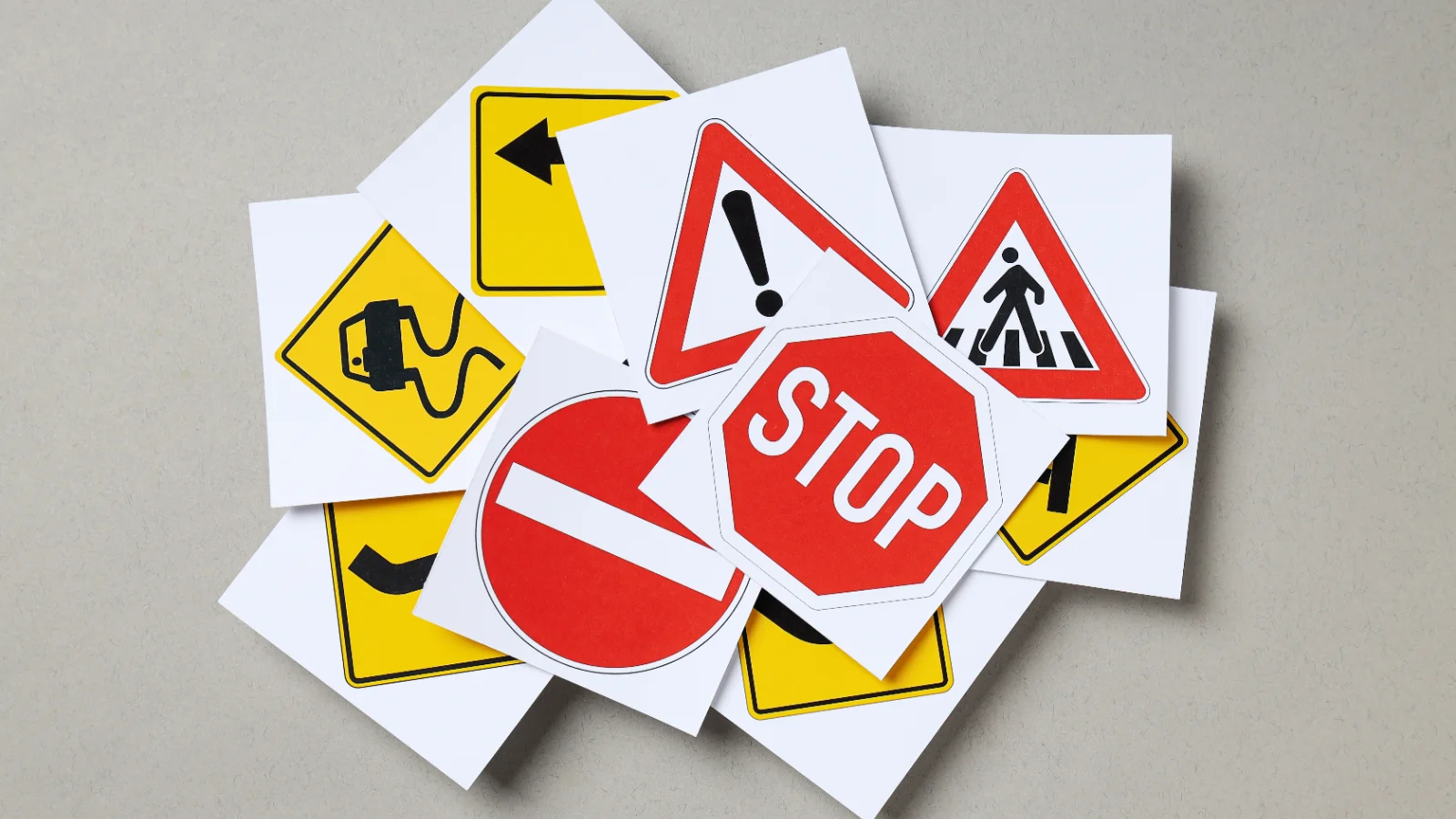
Ready to test your knowledge of U.S. road signs? Take this free road signs practice test to review common traffic signs, understand what they mean, and see where you may need more practice before your DMV permit test.
Read each question and choose the best answer. When you finish, check the answer key and explanations. These are original study questions, not official DMV test questions. For state-specific requirements, review the latest driver handbook from your state’s DMV.
Road Signs Practice Questions
1. What does an eight-sided red sign mean?
A. Yield
B. Stop
C. No passing
2. What should you do when you see a downward-pointing red-and-white triangle?
A. Yield to traffic or people with the right-of-way
B. Continue without slowing down
C. Stop only if a police officer is present
3. What does a yellow diamond-shaped sign with a curved arrow usually indicate?
A. A curve or change in the road ahead
B. A required detour
C. A speed limit
4. What do orange signs usually warn drivers about?
A. A school zone
B. Road work or temporary traffic conditions
C. A hospital nearby
5. What does a “NO TURN ON RED” sign tell you?
A. You may turn after stopping
B. You must not turn while the signal is red
C. You may turn only if no other cars are present
6. What does a red circle and slash over a U-turn arrow mean?
A. U-turns are required
B. U-turns are prohibited
C. U-turns are allowed for trucks only
7. What does a round yellow sign with a black railroad symbol warn you about?
A. A railroad crossing ahead
B. A bike lane ahead
C. A road that ends ahead
8. What does a school-crossing sign help you identify?
A. An area where children may be crossing
B. A school bus stop that is closed
C. A road where only school buses may travel
9. What is the main purpose of a green guide sign on a highway?
A. To warn of a sharp turn
B. To provide route, direction, or destination information
C. To indicate that parking is prohibited
10. What does a railroad crossbuck sign identify?
A. A railroad crossing
B. A no-passing zone
C. A pedestrian-only path
Answer Key and Explanations
- B — Stop. The octagon is the standardized shape for a STOP sign.
- A — Yield. A downward-pointing triangle identifies a YIELD sign. Slow down and be prepared to stop if needed to let conflicting traffic proceed.
- A — A curve or change in the road ahead. Yellow diamond signs are commonly used for warnings, including road conditions that may require extra attention.
- B — Road work or temporary traffic conditions. Orange signs alert drivers to temporary traffic control, such as construction or maintenance.
- B — You must not turn while the signal is red. Follow the posted sign and wait for a permitted signal.
- B — U-turns are prohibited. The red circle and slash indicate that the pictured movement is not allowed.
- A — A railroad crossing ahead. The round warning sign alerts drivers to an upcoming highway-rail crossing.
- A — An area where children may be crossing. School-related signs alert drivers to watch for children and follow posted directions.
- B — Route, direction, or destination information. Green guide signs help drivers navigate roads and highways.
- A — A railroad crossing. A crossbuck marks the crossing itself. Watch for trains and follow any other signs, signals, or gates.
The MUTCD, the Federal Highway Administration’s national manual for traffic control devices, specifies exclusive shapes for several signs, including the octagon for STOP, the downward triangle for YIELD, and the crossbuck for a railroad grade crossing. It also describes diamond signs as part of the warning-sign series. (DOT)
What This Road Signs Practice Test Covers
Road signs communicate important information quickly. Some tell you what action is required, while others warn about a condition ahead or help you find your route. Recognizing a sign by its shape and color can help you understand its purpose, even before you have time to read every word.
This practice test reviews several common groups:
- Regulatory signs communicate rules or restrictions, such as stopping, yielding, or prohibited movements.
- Warning signs alert drivers to road conditions or hazards ahead. Many standard warning signs use a black legend on a yellow diamond.
- Work-zone signs use orange to alert drivers to temporary traffic conditions.
- Guide signs help with routes, destinations, and navigation.
- School and railroad signs alert drivers to specific locations where extra awareness may be needed.
Common sign designs are addressed in the federal MUTCD, but you should still use your state’s driver handbook as your main study resource. State materials help you prepare for local licensing requirements and may include additional signs or rules relevant to your test. (DOT)
How to Use This DMV Road Signs Practice Test
Try to answer all the questions before checking the answer key. If this page uses an interactive quiz, show the correct answers and explanations after the user submits their responses. That lets learners check what they know before seeing the solutions.
When you review a missed question, focus on why the answer is correct. For example, connect a sign’s shape or color with its general purpose, then learn the symbol or message shown on that sign. This is more useful than memorizing answer letters, which may be presented differently on another quiz.
Take the test again after reviewing the questions you missed. Repetition can help you recognize signs more quickly, but practice quizzes should support—not replace—the official study material for your state.
Tips for Studying Road Signs
Start with shapes and colors. Learn the distinctive shapes first, including the octagon for STOP, the downward-pointing triangle for YIELD, and the crossbuck for a railroad crossing. Then review common colors and sign categories.
Study the full sign, not just its outline. A shape can give you a useful clue, but the words, symbols, arrows, and additional panels tell you what the sign means in context.
Practice with explanations. When you get a question wrong, read the explanation and look up the sign in your state handbook. Understanding the meaning helps you apply what you learn to a new question.
Review your state’s driver handbook. A practice quiz is useful for checking knowledge, but your state’s current handbook should be the source you consult for local test preparation.
Pay attention to signs as a passenger. When you are not driving, notice signs on the route and think about what message they give drivers. This can help you connect a sign’s meaning with the kind of road situation where it appears.
Frequently Asked Questions
Is this the official DMV road signs test?
No. This is an independent practice resource with original study questions. It is not affiliated with or endorsed by a state DMV, and it does not guarantee which questions will appear on an official test.
Can I use this practice test for my state’s permit test?
Use it to review common U.S. road signs, then check your state’s current driver handbook for local requirements and test information.
What should I do if I miss a question?
Read the explanation, review the sign in your state handbook, and retake the quiz after studying. Focus on understanding the sign rather than memorizing the answer.
Are road signs the same in every state?
Many common sign designs follow national standards, but your state’s handbook is the right resource for local rules and test preparation. The MUTCD is currently published by FHWA as the 11th Edition with Revision 1, dated December 2025 and effective March 5, 2026. (DOT)